
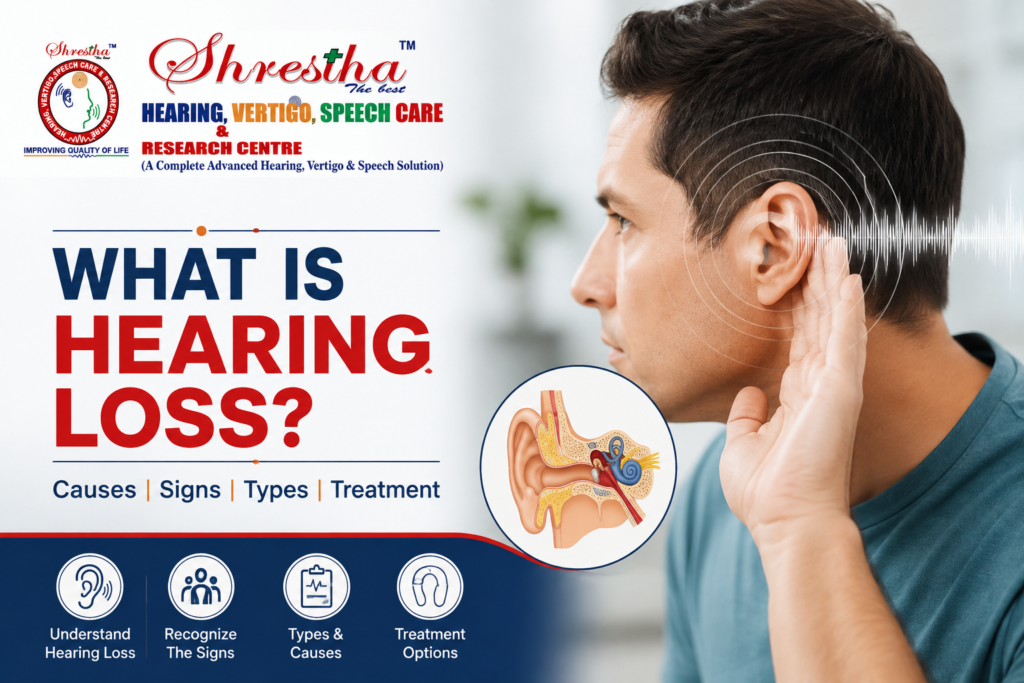
What Is Hearing Loss?
Do you often ask people to repeat themselves, increase the TV volume, or struggle to follow conversations in noisy places? These could be signs of hearing loss and you’re not alone. Hearing loss is one of the most common sensory conditions worldwide, yet it’s often overlooked or dismissed as just getting older or not paying attention.
Understanding what hearing loss is, what causes it and when to seek help can make a real difference in how early it’s identified and managed. Hearing loss can range from mild to profound, and it can affect one ear or both. Recognizing the signs early, rather than waiting for them to become disruptive, allows for timely evaluation and better long-term outcomes for communication, relationships, and daily life.
This guide walks through the basics of hearing loss in simple, easy to understand language, so you know what to look for and what steps to take next.
At Shrestha Hearing, Vertigo, Speech Care & Research Centre, we work with people of all ages to evaluate, understand and manage hearing related concerns. This article is meant to help you understand hearing loss better, not to replace a professional evaluation.
What Is Hearing Loss?
In simple terms, hearing loss means a reduced ability to hear sounds compared to what is typically considered normal hearing. It can affect how clearly you hear speech, how well you detect certain pitches or volumes of sound and how easily you follow conversations, especially in noisy environments.
How normal hearing works, briefly: Sound waves travel through the outer ear, cause the eardrum and middle ear bones to vibrate and are then converted into electrical signals by the inner ear (cochlea). These signals travel through the auditory nerve to the brain, which interprets them as recognizable sounds and speech.
When any part of this pathway, the outer ear, middle ear, inner ear, auditory nerve, or the brain’s hearing centers, is affected, hearing loss can occur.
Temporary vs. permanent hearing loss: Some hearing loss is temporary, caused by things like earwax buildup, fluid from an infection, or short term exposure to loud noise. Other forms are permanent, often involving damage to the inner ear or auditory nerve. Identifying which type you are dealing with is an important part of the evaluation process.
It’s also worth stating clearly: hearing loss is not only an age related problem. While it’s common in older adults, it can affect newborns, children, teenagers and working age adults for a variety of reasons.
What Are the Different Types of Hearing Loss?
Hearing loss is generally grouped into a few main categories, based on which part of the hearing system is affected.
A. Conductive Hearing Loss
This occurs when sound isn’t conducted efficiently through the outer or middle ear. Common causes include:
- Earwax buildup
- Ear infections
- Fluid behind the eardrum
- Problems with the eardrum or middle ear bones
Conductive hearing loss is often treatable, especially when caused by a blockage or infection.
B. Sensorineural Hearing Loss
This type is related to the inner ear (cochlea) or the auditory nerve. Common causes include:
- Aging
- Prolonged exposure to loud noise
- Certain medical conditions affecting the inner ear
Sensorineural hearing loss is usually permanent and is the most common type of hearing loss overall.
C. Mixed Hearing Loss
This is a combination of both conductive and sensorineural hearing loss, meaning a problem exists in both the outer/middle ear and the inner ear or auditory nerve.
D. Unilateral vs. Bilateral Hearing Loss
Hearing loss can affect one ear (unilateral) or both ears (bilateral). Unilateral hearing loss can sometimes go unnoticed longer, since the unaffected ear compensates, but it can still make it difficult to locate sounds or hear well in group settings.
What Causes Hearing Loss?
Several factors, alone or in combination, can contribute to hearing loss:
- Aging
- Prolonged exposure to loud sounds
- Ear infections
- Excessive earwax buildup
- Ear injuries
- Certain medications that can affect hearing
- Genetic or congenital factors
- Head injuries
- Certain underlying medical conditions
- Repeated exposure to workplace noise
Because the cause directly affects the treatment approach, identifying why hearing loss is occurring is a key part of any evaluation.
What Are the Signs and Symptoms of Hearing Loss?
Hearing loss often develops gradually, which is why many people don’t notice it right away. Here’s a checklist of common signs to watch for:
- Frequently asking people to repeat themselves
- Increasing the volume on the TV or phone
- Difficulty understanding speech in noisy environments
- Feeling like people are “mumbling”
- Difficulty hearing during phone calls
- Missing parts of conversations or announcements
- Avoiding social situations due to difficulty hearing
- Ringing or buzzing in the ears (tinnitus)
- Difficulty telling which direction a sound is coming from
When Should I Get My Hearing Checked?
If you notice two or more of the signs above happening regularly, not just occasionally, it’s a good idea to schedule a hearing evaluation. Hearing loss tends to progress gradually, so early evaluation makes it easier to understand your baseline hearing and address any changes sooner rather than later.
Who Can Experience Hearing Loss?
Hearing loss doesn’t only affect older adults. It can occur across all age groups:
- Newborns and children: due to congenital factors, infections, or developmental conditions
- Teenagers and young adults: often linked to noise exposure (loud music, headphones, concerts)
- Working professionals: due to workplace noise or other factors
- Older adults: commonly age related, though other causes can contribute too
It’s important to move away from the assumption that hearing loss is exclusively a senior citizen issue. Anyone, at any age, can experience some degree of hearing difficulty.
How Is Hearing Loss Diagnosed?
A professional hearing evaluation is the only reliable way to determine whether hearing loss is present and if so, what type and degree it is. Self assessment or guesswork isn’t enough, since many causes of hearing loss require specific tests to identify accurately.
Common assessments may include:
- Medical history and ear examination: reviewing symptoms and physically examining the ear
- Pure-tone hearing test (audiometry): measuring the softest sounds you can hear at different pitches
- Speech audiometry: assessing how well you understand speech at various volumes
- Tympanometry: checking the movement and function of the eardrum and middle ear
- Other tests, depending on individual symptoms and findings
The specific combination of tests used depends on your age, symptoms, and overall hearing concerns, so evaluations are typically tailored to the individual.
Can Hearing Loss Be Treated?
Treatment for hearing loss depends on its type, cause, and severity, there is no single approach that works for everyone. A proper evaluation helps determine which of the following may be appropriate:
- Treatment of underlying ear conditions (ex – infections)
- Professional earwax removal and management
- Medical or surgical treatment, when appropriate
- Hearing aids
- Assistive listening devices
- Cochlear implants, for selected individuals with severe to profound hearing loss
- Speech and auditory rehabilitation, when required
The right path forward is always based on an individual assessment, what works well for one person may not be suitable for another.
What Are Hearing Aids and How Do They Help?
Hearing aids are small electronic devices designed to amplify and process sound, making it easier to hear and understand speech, especially in situations that would otherwise be difficult, like noisy environments or group conversations.
Who may benefit: People with certain types and degrees of hearing loss, most commonly sensorineural hearing loss, may benefit from hearing aids after a proper evaluation confirms their suitability.
Styles of hearing aids vary based on design and how they sit in or around the ear, and the right style depends on factors like the degree of hearing loss, ear anatomy, lifestyle and personal preference.
Why proper assessment and fitting matter: Hearing aids are not one size fits all. They need to be selected and programmed based on your specific hearing profile and follow up adjustments are often necessary to fine tune performance as you adjust to using them.
Can Hearing Loss Be Prevented?
While not all hearing loss is preventable (for example, genetic or age-related causes), many everyday risk factors can be managed. Some practical tips:
- Protect your ears from loud sounds
- Use appropriate hearing protection in noisy workplaces
- Keep headphone volume at a safe level
- Take breaks during prolonged noise exposure
- Avoid inserting objects into the ear
- Treat ear infections or problems promptly
- Get regular hearing evaluations when recommended
When Should You See a Hearing Specialist?
Certain signs and symptoms warrant a prompt evaluation rather than a wait and see approach:
- Sudden or rapidly developing hearing loss
- Persistent difficulty hearing conversations
- Hearing loss that’s affecting your work or relationships
- Persistent ringing in the ears
- Balance or dizziness symptoms occurring alongside hearing problems
- Any hearing concerns noticed in a child
- Difficulty understanding speech, even when you can hear that sounds are present
If any of these apply to you or a loved one, don’t delay a professional evaluation. Early assessment leads to a clearer picture of what’s going on and clearer next steps.
Hearing Loss and Quality of Life
Untreated hearing difficulties don’t just affect your ears, they can gradually influence several areas of daily life, including:
- Communication: misunderstandings or difficulty following conversations
- Family relationships: strain from repeated miscommunication or frustration
- Work and education: difficulty following instructions, meetings, or lectures
- Social participation: withdrawing from gatherings or group settings
- Confidence and independence: feeling less sure of oneself in everyday interactions
Addressing hearing concerns early can help support better communication and overall well being, though outcomes vary from person to person based on individual circumstances.
Why Choose Shrestha?
Shrestha Hearing, Vertigo, Speech Care & Research Centre provides comprehensive, patient centered care for hearing and related concerns, with convenient locations in:
☛ Acharya Vihar, Bhubaneswar & Dolamundai, Cuttack
Our services relevant to hearing health include:
- Hearing evaluation
- Hearing aid consultation and fitting
- Vertigo care
- Speech related care
- Hearing rehabilitation
Whether you are noticing early signs of hearing difficulty or have ongoing concerns, our team is here to guide you through a clear, professional evaluation process.
Frequently Asked Questions
What is hearing loss?
Hearing loss is a reduced ability to hear sounds, ranging from mild difficulty to a profound inability to hear, and it can affect one or both ears.
Is hearing loss only caused by aging?
No. While aging is a common cause, people of all ages, including newborns, children, and young adults, can experience hearing loss due to a variety of factors.
What are the first signs of hearing loss?
Common early signs include frequently asking people to repeat themselves, raising the TV volume and struggling to follow conversations in noisy settings.
Can hearing loss be temporary?
Yes. Some causes, like earwax buildup or fluid from an infection, can lead to temporary hearing loss that improves with treatment. Other causes result in permanent hearing loss.
Can hearing loss be cured?
It depends on the underlying cause and type. Some cases (like those caused by earwax or infection) can be resolved, while others, such as sensorineural hearing loss, are typically managed rather than cured.
Do I need a hearing test if I can still hear?
Yes, if you’re having difficulty understanding speech or hearing clearly in noisy environments, a hearing test can help, even if you don’t feel like you’ve lost your hearing entirely.
When should children have their hearing checked?
Children should be evaluated whenever there are concerns about their hearing, speech, or language development, as early identification supports better developmental outcomes.
Can hearing aids restore normal hearing?
No. Hearing aids amplify and process sound to improve hearing ability, but they do not restore hearing to normal in the way glasses fully correct vision for many people. They’re a management tool, not a cure.
Where can I get a hearing test in Bhubaneswar or Cuttack?
Shrestha Hearing, Vertigo, Speech Care & Research Centre offers professional hearing evaluations at our Acharya Vihar, Bhubaneswar and Dolamundai, Cuttack locations.